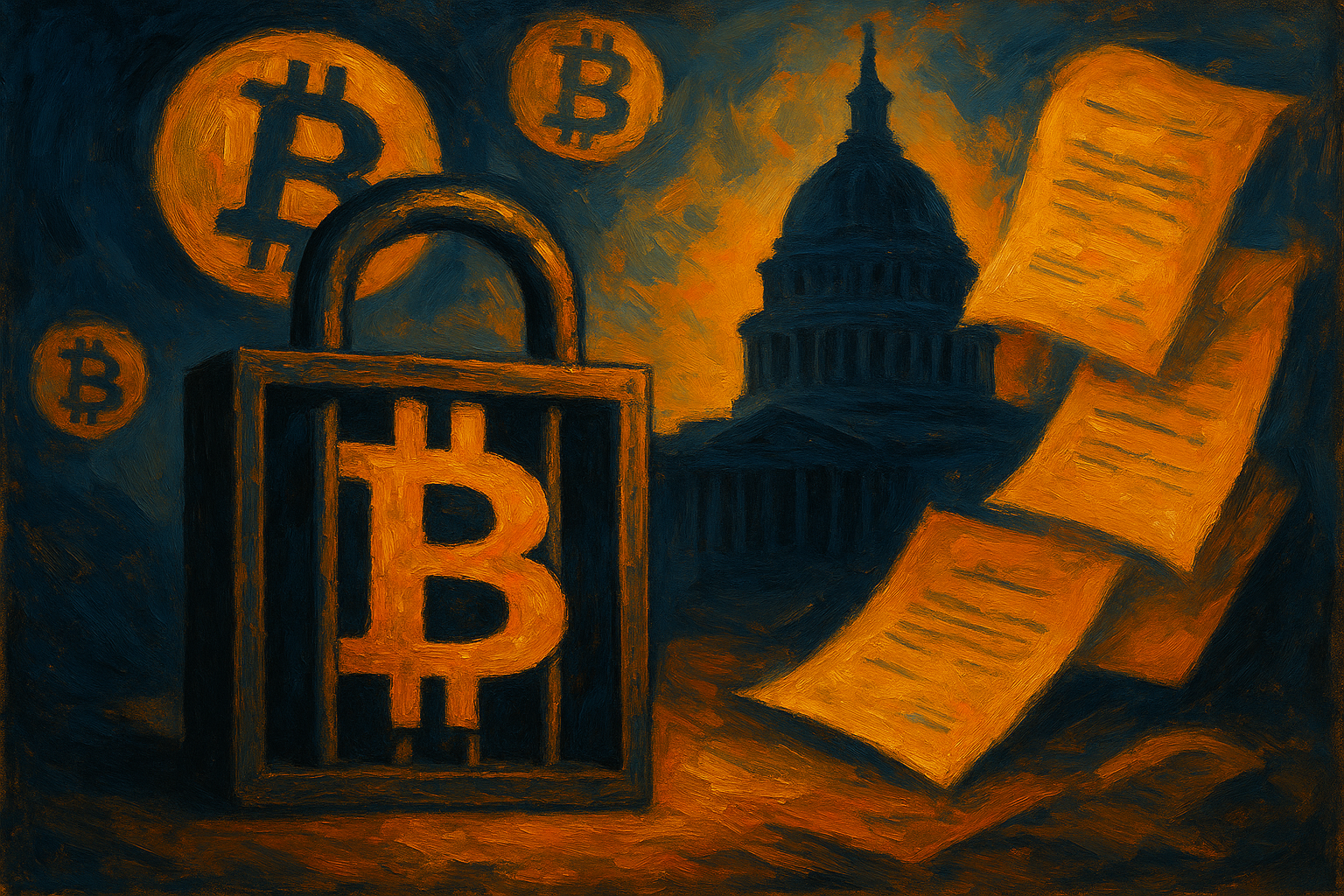
ARMA doesn't buy Bitcoin. It locks up what the government already has — and that's the point.
This isn't about buying Bitcoin. It's about keeping it.
ARMA — the American Reserve Modernization Act of 2026 — landed on May 21 with almost no coverage. That was a mistake. The bill introduced by Rep. Nick Begich (R-AK) and Rep. Jared Golden (D-ME) with 16 bipartisan cosponsors is the most consequential crypto legislation in U.S. history. Not because it acquires Bitcoin. Because it locks it up.
The 20-Year Lockbox
Under ARMA, any Bitcoin deposited into the Strategic Bitcoin Reserve cannot be sold, swapped, auctioned, or disposed of for 20 years. After that, Treasury can sell a maximum of 10% in any two-year window. The government becomes a holder — not a trader.
Think about what that means for the market. The U.S. government currently holds an estimated $26 billion in crypto, according to Arkham Intelligence. That's not a theoretical number — it's actual coins sitting in wallets that have been subject to forfeiture auctions, regulatory seizures, and policy reversals. ARMA ends that. The government is going long.
The bill also mandates quarterly public proof-of-reserve disclosures and third-party audits. Transparency isn't optional — it's written into law. Every quarter, the Treasury secretary has to show the American public exactly what's in the reserve. That's accountability in a way that should appeal to anyone who's been burned by government opacity in the crypto space.
The Acquisition Gap — And Why It's By Design
ARMA quietly dropped the 1 million BTC purchase target from earlier drafts. Instead, it directs Treasury and Commerce to study "budget-neutral" acquisition methods: asset conversion, gold revaluation, tariff revenues, and forfeiture. No direct purchases. No appropriated funds.
Critics will call this hollow. They're wrong. The political reality is that a bill that explicitly funds Bitcoin purchases through Congress dies in committee. A bill that studies "budget-neutral" acquisition methods can pass. The lockbox is what matters. Once Bitcoin is in the reserve, it stays there for 20 years regardless of who controls the Treasury.
The acquisition study is a feature, not a bug. It keeps the bill alive while the real policy — the 20-year hold — becomes law.
The Republican Coalition Is Locked In
Rep. Matt Van Epps (R-TN), a Nashville freshman, introduced companion legislation to codify the reserve. Van Epps isn't alone. The 16 cosponsors span the ideological spectrum, and the pairing of Begich and Golden is intentional — this is not a partisan bill. Bitcoin is becoming a consensus issue in the same way tax cuts were in the 1980s.
The dynamic is shifting. Three years ago, crypto in Congress meant Coinbase and Block battling for regulatory clarity. Now it means actual policy — reserve doctrine, transparency requirements, long-term hold mandates. Bitcoin is being treated like a sovereign asset class, not a speculative instrument.
The Trump Media Irony
While the government locks up Bitcoin for 20 years, Trump Media is down $455 million on its Bitcoin holdings. The private sector can't hold. The government just committed to holding for two decades.
That's not a criticism of Trump Media — it's context. The people who argued "the government is your enemy in crypto" are now watching the government become the most reliable long-term holder on the planet. The question isn't whether the government should own Bitcoin. The question is whether it should own it responsibly. ARMA answers yes.
What This Means for the Market
The supply implications are significant. Government seizures have historically hit the market as auctions — the DOJ's 2020 Bitcoin auctions after Silk Road shut down temporarily depressed prices every time. ARMA removes that pressure. The U.S. government becomes a holder, not a seller.
There's also a geopolitical dimension. Once the U.S. locks in a strategic Bitcoin reserve, other nations face a choice: hold Bitcoin or fall behind in the next reserve currency race. This is the beginning of sovereign Bitcoin accumulation at scale.
The Bottom Line
ARMA isn't perfect legislation. The acquisition mechanisms are vague, the 20-year sunset provisions are complex, and the path from study to implementation is unclear.
But the direction matters. Bitcoin is being treated as a permanent asset, not a temporary holding to be liquidated. The government is being converted from a threat to a backstop. And the accountability mechanisms — quarterly disclosures, third-party audits — are written into law, not buried in regulation.
For the Bitcoin purists who've spent years arguing that the government should stop being a seller: this is the first bill that actually delivers on that. It's not about acquiring more. It's about keeping what you have.
The market barely blinked when ARMA was introduced. That tells me most people haven't processed what's happening. The U.S. government is building a 20-year Bitcoin hold. That's not a regulatory tweak. That's a strategic reserve doctrine — and it's arriving faster than anyone expected.
Sources:
The Block: ARMA 20-Year Lockup Provision